What is a podcast? Definition, types and the origin of the word
A podcast is a series of audio or video episodes you can enjoy whenever you want. We explain what it is, which types exist, how it differs from radio and YouTube, and how the word was born.
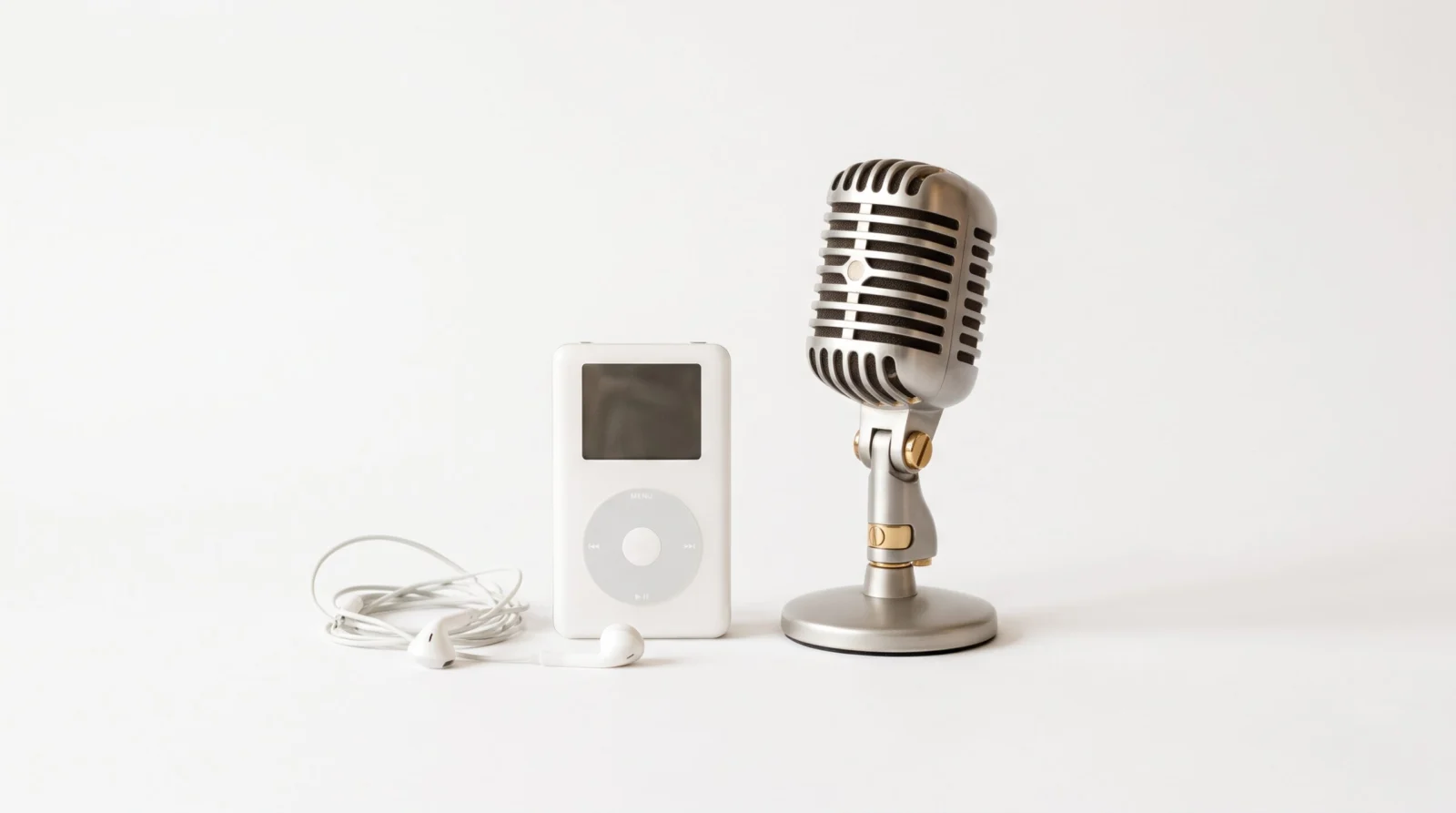
The first time I saw the word podcast was in Apple's products, many years ago: the iPod and iTunes had a new section with a name nobody quite knew how to pronounce. Today we hear it every day, but few people know exactly what it is, where it came from or why it's called that.
At Trazotres.com we produce video podcasts in Puebla, Mexico, so here is the full picture: what a podcast is, which types exist, how it differs from radio or a YouTube video, and the story behind the word.
What is a podcast?
A podcast is a series of audio or video episodes published online that you can listen to or watch whenever you want. Each episode covers a topic, usually with the same hosts, and followers get new episodes automatically in their app.
Three traits set it apart:
- It's a series. It isn't a one-off recording: episodes come out on a regular schedule, for example every week.
- It's on demand. There's no broadcast schedule like radio: you listen whenever you like, in the car, at the gym or at home.
- You subscribe or follow it. Podcast apps let you know when a new episode is out and have it ready for you.
Today many podcasts are also recorded on video, with cameras in the studio, and published on YouTube as well as in audio apps. That's called a video podcast.
Types of podcasts
There's no single way to make a podcast. These are the most common formats:
- Interview. One host welcomes a different guest each episode. It's the most popular format for brands and experts.
- Conversation. Two or more hosts talk about a topic; their chemistry is what hooks the audience.
- Monologue. One person shares what they know: advice, analysis, reflections.
- Narrative or documentary. Tells a true story across several episodes, with research and more elaborate editing.
- Fiction. Modern radio dramas, with actors, music and sound effects.
- Branded or corporate. A company creates its own show to talk about its industry and get closer to its customers.
Any of them can be audio-only or recorded on video. The choice depends on where your audience is and how much you want to show on camera.
Podcast, radio and YouTube video: the differences
| Podcast | Radio | YouTube video | |
|---|---|---|---|
| When you consume it | Whenever you want | At broadcast time | Whenever you want |
| Format | Series of episodes | Continuous programming | Single videos or series |
| How it reaches you | Subscription in an app | You tune in to a station | Search or recommendations |
| Typical length | From 20 minutes to over an hour | Blocks of hours | Highly variable |
| Works without a screen | Yes | Yes | Usually needs a screen |
The line between podcasts and YouTube keeps getting thinner: many shows publish the same episode in both places. Further down we share what we think still sets them apart.
Where do you listen to or watch a podcast?
The most popular platforms are Spotify, Apple Podcasts, YouTube and Amazon Music. They all work the same way: you find the show, tap follow or subscribe, and new episodes appear in your library on their own. You can download them to listen offline.
For creators, this means the same episode can reach people listening in the car and others watching on the TV at home.
The word: iPod + broadcast
On February 12, 2004, British journalist Ben Hammersley wrote in The Guardian about a new phenomenon: ordinary people recording audio shows and publishing them online for anyone to download. Looking for a name, he suggested a word: podcasting.[1]
The word combines two terms: iPod, Apple's music player that was all the rage back then, and broadcast, as in radio. Hammersley has said he came up with it almost in passing, to fill out an article that had come up short.[2] Without knowing it, he was naming an entire medium.
The idea existed before the name
The technology came before the name. From 2000 on, programmer Dave Winer and former MTV host Adam Curry worked on distributing audio through RSS: a subscription system that tells you when a new episode is out and downloads it automatically. Curry even built a program with Kevin Marks called iPodder to send those episodes straight to the iPod.[3]
That's still the heart of a podcast today: it's not a single file, it's a series you subscribe to that reaches you episode after episode.
2005: the year Apple took it mainstream
Throughout 2004, podcasting was something for tech enthusiasts. Everything changed on June 28, 2005, when Apple released iTunes 4.9 with a directory of more than 3,000 free podcasts, one-click subscriptions and automatic syncing with the iPod.[4]
“Podcasting is the next generation of radio”Steve Jobs, in Apple's 2005 press release
That same year, the New Oxford American Dictionary named podcast its word of the year for 2005.[5] In less than two years, a term invented to pad out an article had made it into the dictionary.
- 2000Winer and Curry explore how to distribute audio through RSS.
- February 2004Ben Hammersley uses the word podcasting for the first time.
- June 2005Apple adds podcasts to iTunes and the iPod.
- December 2005“Podcast” becomes word of the year.
- October 2014Serial becomes the first podcast to reach five million downloads.
From niche to phenomenon
For years, podcasting grew slowly, until October 2014 brought Serial, an investigative journalism series that became a phenomenon: it was the first podcast to reach five million downloads and the first to win a Peabody Award.[6] From then on, media outlets, brands and creators around the world turned their attention to the format.
Then came video. Today, according to Edison Research, about a third of podcast listeners in the United States prefer YouTube, ahead of Spotify and Apple Podcasts.[7] The podcast that was born to be heard on an iPod is now watched too.
We produce your video podcast in Puebla: we help you with the script, record with studio quality and deliver every episode ready to publish.
So, is a video interview a podcast?
Today almost any conversation recorded with two microphones in front of a camera gets called a podcast. Purists will say no: a podcast is a series of episodes distributed by subscription, not a one-off interview uploaded once.
We're not that attached to etymology. Words evolve, and video is already part of podcasting. But we do think something sets it apart: continuity. A standalone interview is a good video; when it becomes a recurring date with your audience, with its own topic and voice, it becomes a podcast. That's why, when we produce a video podcast, we plan it by episodes, not as a single video.
And the format has left the studio: podcasts are now also recorded at weddings and parties, capturing the guests' stories. We call it Event Podcast, and we explain how it works in wedding podcast: the trend that's here to stay.
What do you need to make a podcast?
More than gear, you need clarity. These are the steps we follow with every client:
- An idea and an audience. What you'll talk about and for whom. The more specific, the better.
- A format. Interview, conversation or monologue; length and publishing frequency.
- A script or run sheet. Not to read word for word, but to keep the thread. We explain how in how to write a podcast script, and you can write it in our script typewriter.
- Good audio. One microphone per person and a room without echo are worth more than an expensive camera. For a video podcast, add cameras and lighting.
- Editing. Clean up the audio, cut silences, add music and, on video, switch cameras to keep it dynamic.
- Consistent publishing. Upload it to the platforms and cut short clips for social media. Consistency is what makes a podcast grow.
A note for Spanish speakers: podcast or pódcast?
The Royal Spanish Academy suggests adapting the word to Spanish with an accent: pódcast, with an invariable plural: los pódcast.[8] In everyday use, especially in Mexico, the most common form is still podcast, without the accent. Both are understood; what matters is what you say in it.
Twenty years after that article in The Guardian, the podcast went from an experiment to one of the most personal ways to tell stories. If you have something to say too, message Faty and let's talk.
Sources
- Ben Hammersley, The Guardian (February 12, 2004)
- Wikipedia: Ben Hammersley
- The Podcast Host: When did podcasts start?
- Apple Newsroom: press release, June 28, 2005
- Macworld: “Podcast” is the word of the year for 2005
- HISTORY: Serial debuts (October 3, 2014)
- eMarketer, with Edison Research data: preferred platforms for listening to podcasts
- Royal Spanish Academy, Word Observatory: pódcast