How to write a podcast script: run sheet, parts and template
You don't need to write every word, you need to know where you're going. Which kind of script your podcast needs, which parts it has and a run sheet template ready to copy.

When we recorded our first podcast, with a lapel microphone and towels hanging on the wall, we didn't have a word-for-word script. We had a sheet with the key points we couldn't forget. Years later we still work almost the same way, and it's the first thing we recommend to anyone starting out: you don't need to write every word, you need to know where you're going.
At Trazotres.com we produce video podcasts in Puebla, Mexico, and every episode starts on paper. Here we explain what kind of script your podcast needs, which parts it has, and we give you a template to copy.
Full script or run sheet?
Radio distinguishes two kinds of script. The full script contains everything the hosts will say, with music and sound effect cues marked. The technical script, also called a run sheet or outline, focuses on the show's order and section changes, and keeps the hosts' text to a minimum. A script can also be open, if it allows changes on the fly, or closed, if it doesn't.[1]
For a podcast, a mix almost always works best: an open run sheet for the conversation and a few fully written parts, like the intro and the outro.
Which kind of script your podcast needs
It depends on the format. Buzzsprout, one of the most widely used podcast hosting platforms, sums it up like this:[2]
- Interview: a guide with the guest introduction, the topics and the questions in order. They recommend sending it to the guest about a week before recording.
- Conversation between two or more hosts: a run sheet is almost mandatory. Without it, people interrupt each other and the episode wanders off, especially with three or more hosts.
- A single host explaining a topic: a detailed outline, without reading it word for word.
- Fiction or documentary: here you do write everything, and you need lots of practice so it doesn't sound read.
There's a practical reason not to write everything for a conversation: podcasts and audiobooks are spoken at about 150 to 160 words per minute.[3] A one-hour episode would be more than 9,000 words, the length of a book chapter. Nobody writes that, and if you read it, it shows.
The parts of a podcast script
These are the pieces almost every podcast uses. Not all are required, but it helps to keep the intro and outro the same in every episode so your audience recognizes them.[2]
- Intro: what the episode is about and why it's worth sticking around. It's the only part we recommend writing in full.
- Guest introduction: who they are and why they know the topic, in two or three sentences.
- Topic blocks: each with a main idea, supporting points, a fact or an example, and how many minutes you'll give it.
- Transitions: a phrase or a short sound cue to move from one block to the next.
- Recap: the two or three ideas people should take away.
- Outro and call to action: one clear ask. If you ask people to follow, comment and visit your website all at once, they won't do any of it.
In our video podcast packages, we define the topics, guests and structure of each episode with you before recording.
Run sheet template for a 45-minute episode
This is the structure we use as a starting point. Copy the text, adjust the times to your format and fill each block with bullet points, not paragraphs.
EPISODE: [number] — [title]
GUEST: [name], [what they do]
GOAL: The listener takes away [one specific idea]

00:00  INTRO (fully written, 30 to 45 seconds)
       Greeting + what the episode is about + why it matters

01:00  GUEST INTRODUCTION
       Who they are / why they know the topic / a fun fact

03:00  BLOCK 1: [topic]
       • Main question or idea
       • Supporting point / example / fact
       • Follow-up question if the answer is short

15:00  TRANSITION
       Bridge phrase: "And speaking of that…"

16:00  BLOCK 2: [topic]
       • …

28:00  BLOCK 3: [topic]
       • …

40:00  RECAP
       The 2 or 3 key ideas of the episode

43:00  OUTRO (fully written)
       Thanks + ONE call to action + preview of the next episode
Free tool
Write your script in our typewriter
Choose whether it's an interview, a solo episode or a conversation, and we set up the page with this structure so you only write what you'll say. You can download it as text or print it to PDF.
Open my typewriter No sign-up. Your text is saved only in your browser.How to write so it sounds natural
- Write the way you talk. Short sentences, simple words, no “furthermore” or “it is worth mentioning”. If you wouldn't say it in a conversation, don't write it.
- Read it out loud before recording. Where you stumble, change the sentence. Where you run out of breath, add a period.
- Write open questions. “How did it all start?” gets a story; “Did you start in 2018?” gets a yes.
- Mark times, not words. The run sheet tells you when to change topics; the conversation does the rest.
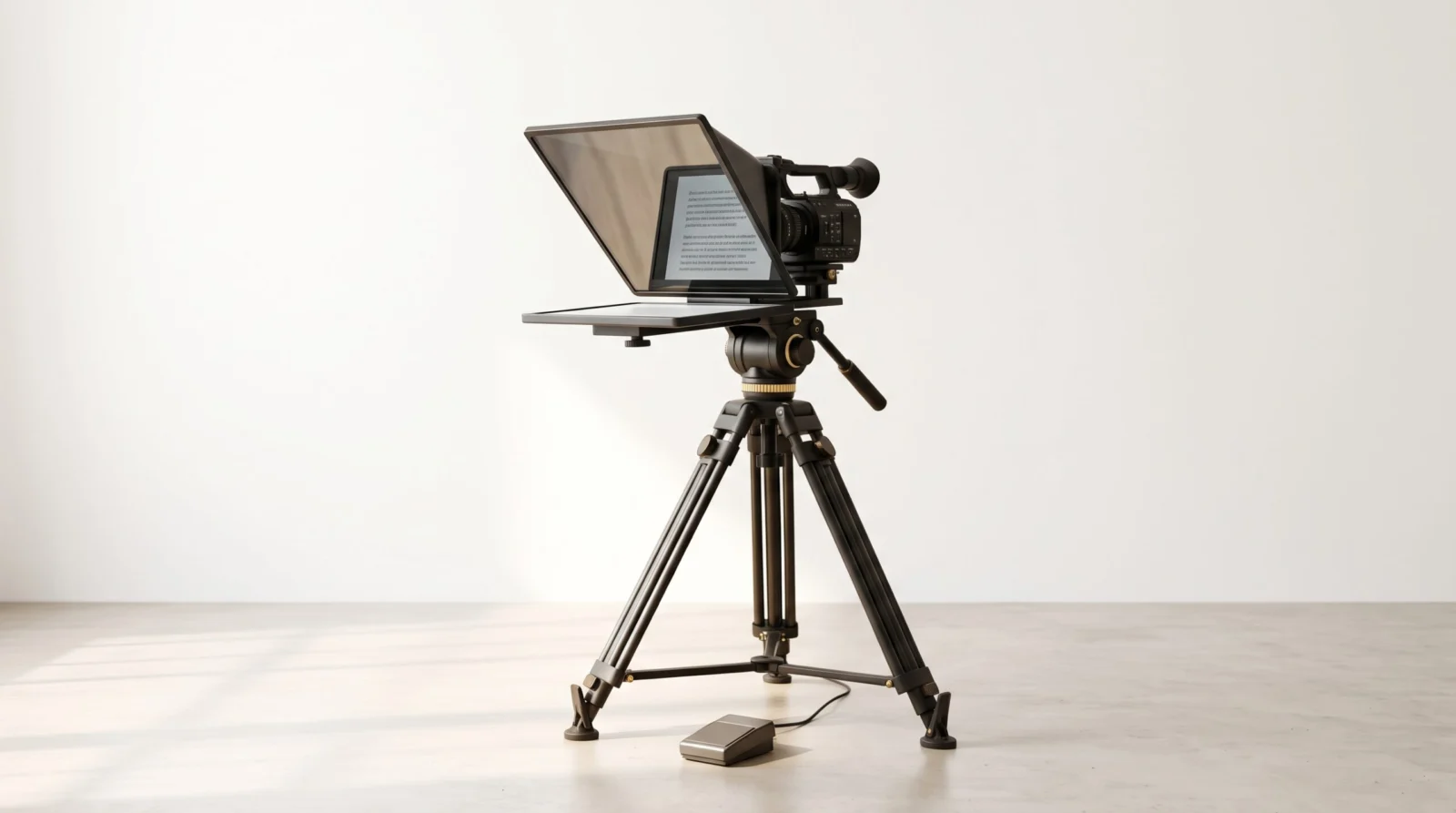
- Use a teleprompter only for the fully written parts. The intro, the outro or a fact you can't get wrong. We explain how in how to use a teleprompter without sounding like a robot, and you can practice with our free online teleprompter.
How we do it at Trazotres.com
Before every recording day we sit down with the client to define the topics and build the run sheet for each episode. Faty writes the scripts by hand, without artificial intelligence, because everyone speaks differently and the script has to sound like the person who will say it. When the guest arrives on set, they already know what we'll talk about and in what order, and it shows: they speak more calmly and editing is faster.
If you're just starting, you might also like our story of how we went from a lavalier and towels on the wall to a cinema camera, and learning where the word podcast comes from. And if you'd like us to build your podcast's run sheets with you and record it, message Faty.